
The Hidden Cost of Avoiding Difficult Conversations: The conversation you delay does not disappear. It changes ownership, meaning and cost.
Avoiding a difficult conversation does more than delay feedback. It creates leadership debt, transfers the cost of poor performance to other people and quietly teaches the team which standards are real and which standards are optional.
Most leaders know when a difficult conversation needs to happen. They see the missed commitment, the unresolved tension, the inconsistent performance or the behavior that is beginning to affect other people. The uncertainty is rarely about whether something is wrong. The uncertainty is about whether the leader should address it now or wait for more evidence.
In more than four decades of leading teams and developing leaders, I have learned that waiting is not a neutral decision. The problem does not remain in the same condition while the leader decides what to do. It begins changing the expectations, workload and trust around it.
I think of this as leadership debt. Like financial debt, it may provide temporary relief, but interest begins accumulating immediately. The interest appears as ambiguity, resentment, rework, emotional tension, lost credibility and extra pressure on the people who continue meeting the standard.
WHY THIS MATTERS
49% of more than 70,000 manager candidates assessed by DDI failed to demonstrate effective conflict management skills.
12% showed high proficiency in conflict management.
4× Gallup reports that employees receiving weekly, meaningful feedback are four times more likely to be engaged, yet only 21% strongly agree they received it in the past week.
The research supports the need for stronger leadership practice, but the deeper issue is not simply that managers dislike conflict. It is that many leaders do not recognize everything that changes after the first moment of avoidance.
An Issue Becomes a Pattern, Then Permission
One missed deadline may be an isolated issue. A second missed deadline begins to look like a pattern. When the pattern continues without a response, it becomes permission. This is one of the most important distinctions a leader can understand. Culture is not shaped only by the values an organization publishes or the expectations a leader communicates. Culture is shaped by the behavior the leader repeatedly allows.
The team is always comparing the stated standard with the lived standard. When those two standards are different, employees learn to trust what the leader tolerates more than what the leader says.
The real standard is not what the leader announces. It is what the leader consistently reinforces.
Avoidance Transfers the Cost
Leaders often think avoiding the conversation keeps the situation contained. In reality, the cost is transferred to other people.
When one person does not deliver, a reliable employee stays late, checks the work, calms the customer or completes the unfinished task. Strong performers become the unofficial shock absorbers for leadership avoidance. They keep the operation moving, but they also begin questioning whether their effort is valued or simply expected.
This is why unresolved accountability eventually becomes a retention issue. The employee creating the problem may feel little immediate consequence, while the people carrying the standard experience the greatest burden.
A leader should ask a direct question before postponing a conversation: Who will carry the cost if I do not address this now? The answer is rarely no one.
Three Clocks Start Running
Once a leader recognizes an issue, three clocks begin running at the same time. Each clock measures a different form of risk, and none of them stops simply because the leader has not scheduled the conversation.
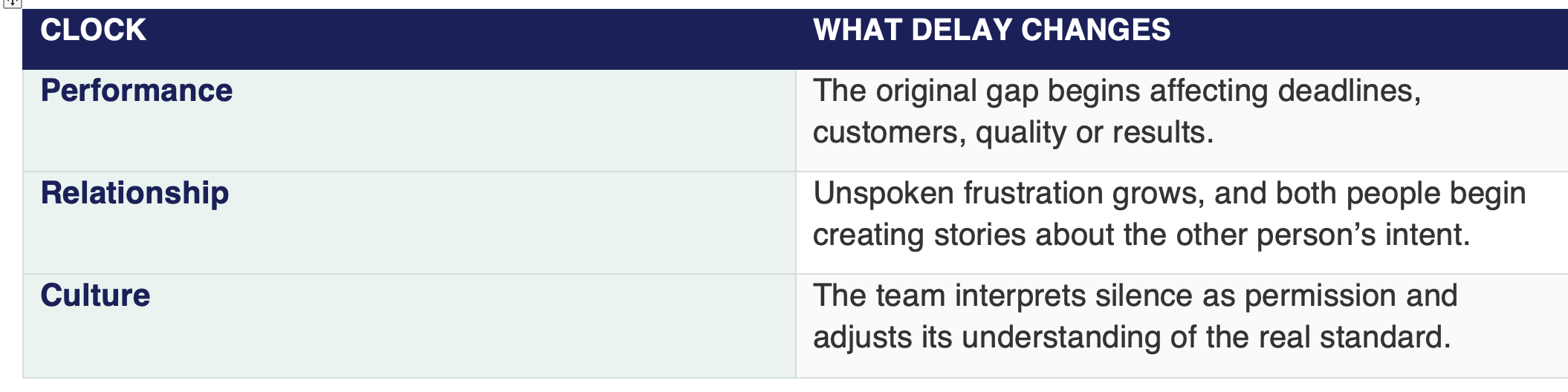
The coaching window is usually widest at the beginning, when the facts are current and the issue has not yet become personal. As time passes, the conversation requires more history, more explanation and more emotional repair. What could have been a short developmental discussion becomes a formal performance conversation.
The Leader and Employee Are Often Living in Different Timelines
A delayed conversation creates an imbalance that many leaders do not anticipate. The leader may have been thinking about the issue for weeks. During that time, frustration has increased and the leader has mentally reviewed every example. The employee may be hearing the concern clearly for the first time.
This is why delayed directness can feel harsher than timely directness. The leader enters the conversation carrying accumulated emotion, while the employee enters with limited information. The leader feels the issue has been obvious. The employee feels the reaction is sudden.
Good leaders do not wait until their frustration becomes the message. They address the issue while they can still separate the person from the behavior and the facts from the story they have begun telling themselves. Before Addressing the Person, Diagnose the Gap
Not every performance problem is an accountability problem. One of the fastest ways to damage trust is to confront someone for a failure the system helped create or for an expectation that was never clear.
Before the conversation, I recommend diagnosing four possible gaps. The response should be different depending on what the leader discovers.
Before Addressing the Person, Diagnose the Gap
Not every performance problem is an accountability problem. One of the fastest ways to damage trust is to confront someone for a failure the system helped create or for an expectation that was never clear.
Before the conversation, I recommend diagnosing four possible gaps. The response should be different depending on what the leader discovers.
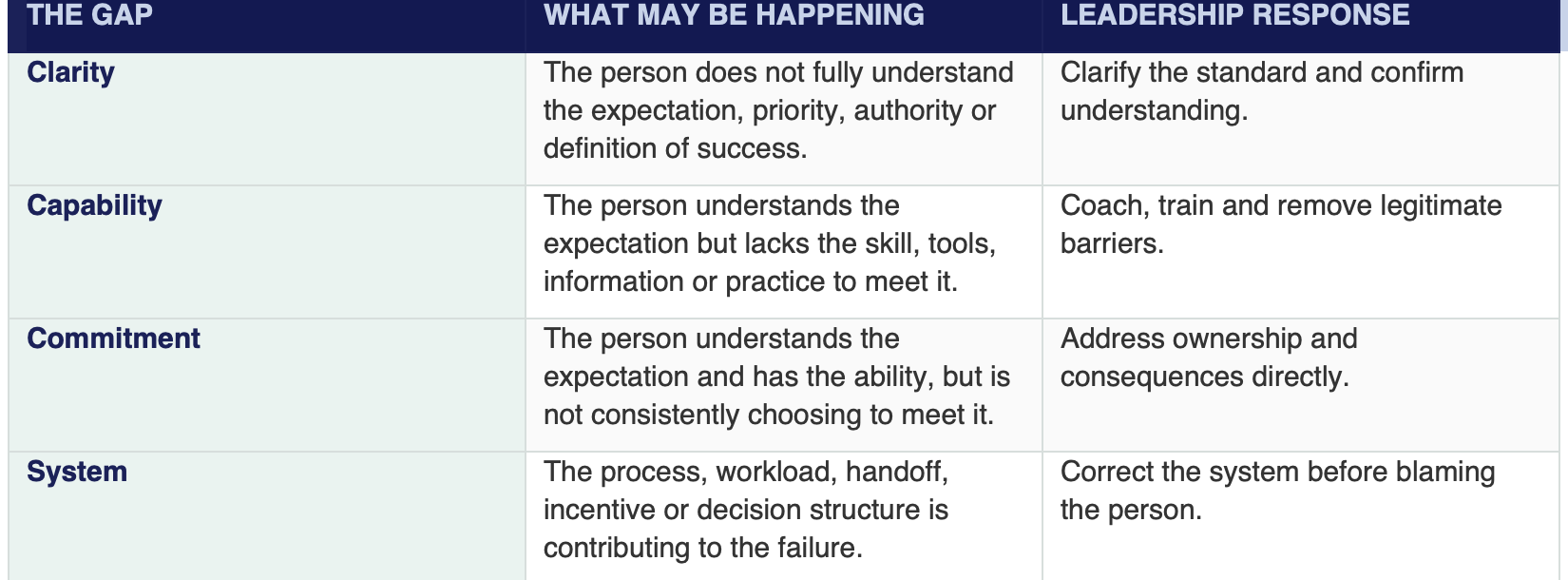
Leaders often move too quickly to the commitment gap because it looks like an attitude problem. Strong leadership starts with enough curiosity to rule out a clarity, capability or system gap. Once those have been addressed, the leader can hold the person fully accountable for the choices that remain.
The Five R Conversation Reset
A difficult conversation should not be a release of frustration. It should be a structured reset that restores clarity, responsibility and forward movement. The following Five R approach keeps the discussion direct without making it personal.