
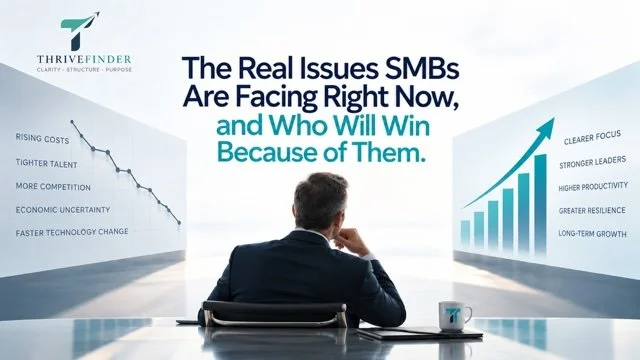
Most SMBs are not losing because they lack effort. They are losing because the way business works has changed, and they are still operating on a model that used to work. After more than 30 years building and advising organizations, I have seen this pattern before. The companies that adjust early separate, while the ones that do not slowly feel the pressure without always understanding what is causing it.
What is happening right now is not subtle, but it is often misunderstood, and it is already creating a clear line between the businesses that are starting to pull ahead and the ones that are beginning to fall behind.
Artificial intelligence is no longer a future initiative; it is a current capability gap. Many SMBs are either ignoring it or experimenting around the edges, which feels productive but does not materially change how work gets done. The companies gaining ground are embedding AI into their sales process, their customer conversations, their forecasting, and their operations. The difference is not access, because everyone has access. The difference is integration. Those who operationalize it will gain efficiency, insight, and speed, while those who delay will find themselves competing against companies that are simply faster and more informed.
At the same time, buyers have changed more than most sellers realize. Before a conversation ever happens, buyers already understand your competitors, your pricing range, and your alternatives. Research from Forrester continues to show that a significant portion of the buying decision is made before a seller is engaged. Businesses that align their messaging and sales approach to this reality will earn trust earlier and convert more effectively, while those still relying on product pitches and late-stage persuasion will continue to see declining results.
Talent dynamics have shifted as well. Strong people are not disappearing; they are becoming more selective. They want clarity in expectations, consistency in leadership, and a path to grow. When those elements are missing, they leave. Companies that build real leadership systems will attract and retain strong talent, while those that continue to operate reactively will see ongoing turnover and inconsistent performance.
Margin pressure is also intensifying. Costs continue to rise across labor, supply chain, and capital, while customers push back on pricing. Trying to solve this by simply increasing sales activity is not a strategy, it is a reaction. Businesses that bring discipline to pricing, operations, and value communication will protect and even expand margins, while those that rely on volume without structure will see profitability erode over time.
What I see consistently when evaluating SMB businesses is a lack of forward thinking. Many are focused on the next quarter, or at best the next year, but very few have a clear three year plan for how they will continue to grow revenue, stay competitive, and deliver a superior customer experience. Without that level of clarity, decisions become reactive, priorities shift too often, and the business never builds real momentum.
Closely tied to this is one of the most common inflection points in a growing company, which is the transition of the owner or CEO from doer to leader. Many founders built their business through direct involvement, making decisions, solving problems, and driving results personally. That works early, but it does not scale. When that shift to delegation and leadership does not happen, the business eventually slows down because everything still runs through one person. At that point, the CEO becomes the bottleneck to the very growth they are trying to achieve.
I worked with a company that had flatlined their revenue for several years, not because of market conditions, but because they lacked a defined sales structure. Over a six month period, we put the necessary structure in place, clarifying roles, building a repeatable process, and aligning their team around consistent execution. The following year, they increased revenue by more than 25 percent. Nothing about their market changed. Their structure did.
Underneath all these challenges is the issue most leaders are not measuring, which is structure. When priorities are unclear, ownership is vague, and execution varies from week to week, growth becomes inconsistent. It may spike, but it does not sustain. The companies that build structure into how they operate will create consistency and scale, while those that rely on effort will continue to experience volatility.
The separation between winners and losers is already happening.
The winners are not necessarily the largest companies; they are the most aligned and intentional. They are embedding AI into how work gets done, aligning their sales approach to how buyers make decisions, and building operating rhythms that create clarity and accountability, so performance becomes repeatable. They are also thinking ahead, with a clear multiyear view of where the business is going, and leaders who have made the shift from doing the work to leading the business. They invest in developing their people because they understand that capability drives long term capacity, and they expand beyond a single revenue stream by adding services, recurring models, or lifecycle offerings that stabilize the business and improve margins.
The businesses that will struggle are just as clear. They are waiting for certainty before acting on AI, which will leave them behind. They are still leading with product and price instead of insight and alignment. They avoid structure because it feels restrictive, even though it is what enables scale. They remain stuck in short term thinking without a clear path forward, and they fail to make the transition from founder led execution to leadership driven scale. As a result, they treat people as interchangeable, lose their best talent, and stay busy without becoming aligned, confusing activity with progress.
This is not a market where effort alone creates advantage. Effort still matters, but it is no longer the differentiator. Clarity, structure, and alignment are what separate the businesses that will grow from the ones that will feel like they are working harder every quarter just to stay in the same place.
If you are leading a business right now, it is worth stepping back and asking a simple question. Are you building a business that can scale, or are you relying on effort to carry you? Most leaders already know the answer when they take the time to think about it honestly.
If you want an outside perspective on where your gaps are and what to prioritize, visit www.thrivefinder.com and schedule a conversation.